In the world of auto repair, there is a painful rite of passage known as the “slipped wrench.” It happens in a split second: you’re applying max pressure to a stubborn bolt, the tool flexes or snaps, and your knuckles meet the jagged edge of the frame at high speed.
At Orion Motor Tech ball joint removal tool, we’ve spent 20 years studying tool failure so our customers don’t have to experience it. One of the most important decisions we make when engineering a new puller, press, or spacer is the manufacturing process. Usually, that comes down to a battle of the titans: Forged vs. Cast.
Understanding the difference isn’t just “shop talk”—it’s what stands between a successful repair and a trip to the emergency room.
The Cast Process: The Molded Approach
Casting is like baking a cake. Metal is heated until it’s liquid, poured into a mold, and allowed to cool.
-
The Benefit: It’s cost-effective and allows for complex shapes.
-
The Downside: As the liquid metal cools, tiny air bubbles (porosity) can become trapped inside.
-
The Risk: Under extreme pressure—like when you’re using a ball joint press—those microscopic air pockets become “stress risers.” A cast tool won’t usually bend when it fails; it shatters like glass, sending metal shards flying.
The Forged Process: Strength Through Pressure
Forging is the process OMT chooses for our high-stress tools. Instead of melting the metal, we take a solid block of steel, heat it until it’s “plastic” (but still solid), and then use massive hammers or presses to beat it into shape.
-
Grain Flow: Think of wood grain. Forging forces the internal “grains” of the steel to follow the shape of the tool. This creates a continuous, reinforced structure.
-
Density: Because the metal is hammered, it is much denser than cast metal.
-
The Safety Factor: If a forged tool is pushed past its limit, it is designed to deform or bend before it breaks. This gives you a split-second warning to let off the pressure, saving your vehicle and your knuckles.
Why It Matters for Your Garage
When you’re shopping for tools, you’ll see two identical-looking kits with very different price tags. Here is why OMT prioritizes forged materials for specific tasks:
1. Ball Joint Presses
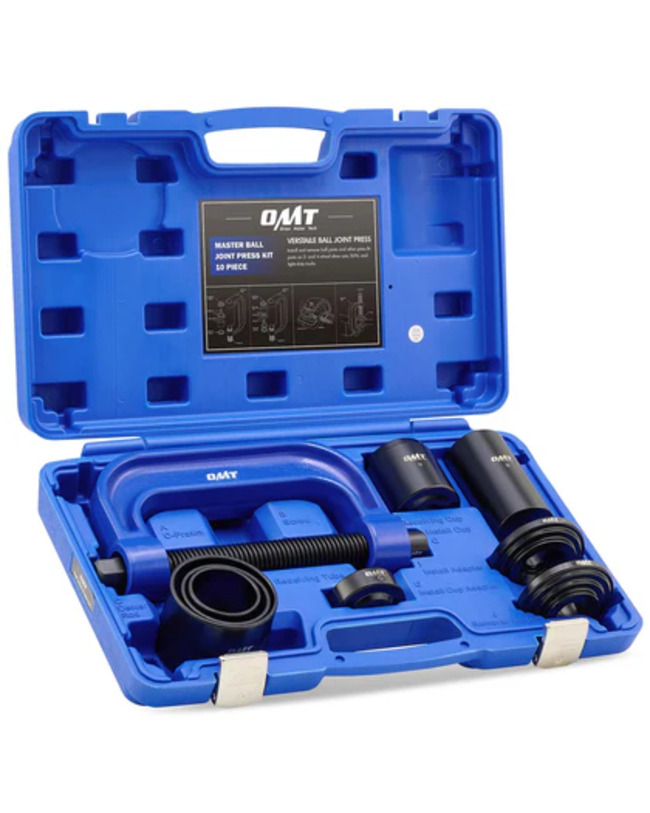
A ball joint can require several tons of force to break free from 10 years of rust. A cast C-frame will “spring” or flex, losing the energy needed to pop the joint. Our OMT Forged Steel C-Frames stay rigid, directing 100% of the force into the bolt.
2. Pitman Arm and Gear Pullers
These tools use a threaded screw to pull heavy components apart. If the “jaws” of the puller are cast, they can snap under tension. We use drop-forged, heat-treated alloy steel to ensure the jaws grip tighter the harder you pull.
3. Wheel Spacers
This is where the debate gets critical. Some “bargain” spacers are cast aluminum. At OMT, our spacers are CNC-machined from 6061-T6 Billet Aluminum. This is a “wrought” (forged-adjacent) material that offers superior fatigue resistance—meaning it won’t crack after thousands of miles of road vibration.
The OMT 20-Year Promise
For two decades, we’ve refused to cut corners on metallurgy. We know that our users are often working in tight spaces, under heavy vehicles, and against seized bolts. You need to trust that when you lean into a tool with all your weight, that tool is going to hold.
By choosing forged and heat-treated steel, we provide the “best-in-class” durability that professionals expect, while maintaining the value that DIYers need.
Are you tired of tools that flex when they should pull?
Would you like me to help you find the forged steel OMT puller or press kit that is specifically rated for the heavy-duty work your truck or SUV requires?